Case study | UX / UI · AI · Public product
Digitalizing the procurement process with an AI-powered platform
I designed the functional prototype of an AI-powered platform for public procurement management, as part of Sciling's technical proposal to the Móstoles City Council.
Role
Product Designer
UX, UI and interaction design with AI
Team
3 people
1 Designer · 2 business profiles (domain advisory)
Duration
1 month
July – August 2024
Tools
Figma
Research · Prototyping · AI
TL;DR
Understand the project in 3 key points
01
CONTEXTSciling was bidding on a public tender to develop an AI-powered platform. The prototype was not an add-on — it was part of the technical argument of the proposal.
02
ACTIONI learned the domain of public procurement in record time to translate complex legal requirements into clear user flows, designing an experience where AI automates without removing control from the user.
03
RESULTI designed an end-to-end prototype covering the entire procurement process, integrating AI at critical points with traceability, user control and auditable decisions.
Context
Designing a product under the rigor of a public tender
Sciling was participating in an Innovation Partnership convened by the Móstoles City Council to develop a platform that automated public procurement management using AI.
The prototype had a key role: it was not just a visualization, but part of the technical argument of the proposal. It had to demonstrate that the solution was viable in an environment where every decision has legal implications.
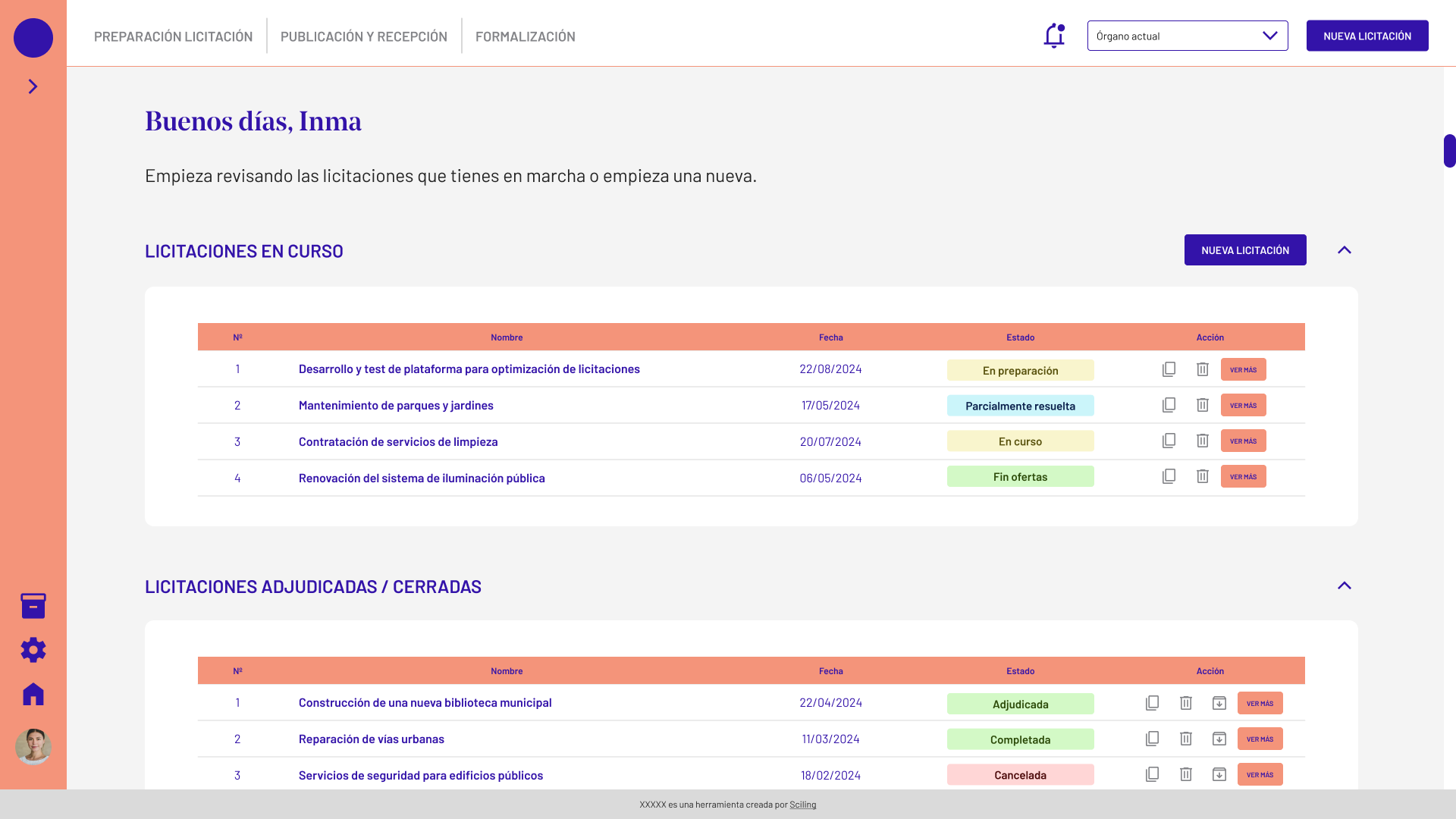
Understanding bureaucracy to maintain legal rigor
In public procurement, each phase follows a strict order, each document has a specific name and any error can lead to legal challenges. The municipal officer using this platform works under legal responsibility and cannot afford to have the system do something they don't understand.
The central tension was clear from the start: automate enough to reduce operational load and design it appropriately to not introduce opacity or turn the system into a black box.
With a one-month timeline, this meant understanding the domain well enough not to oversimplify it. I analyzed the procurement documents for the project and other reference ones to understand their structure, and decomposed the process with support from the business team until I could map the complete flow before beginning to conceptualize the product design.
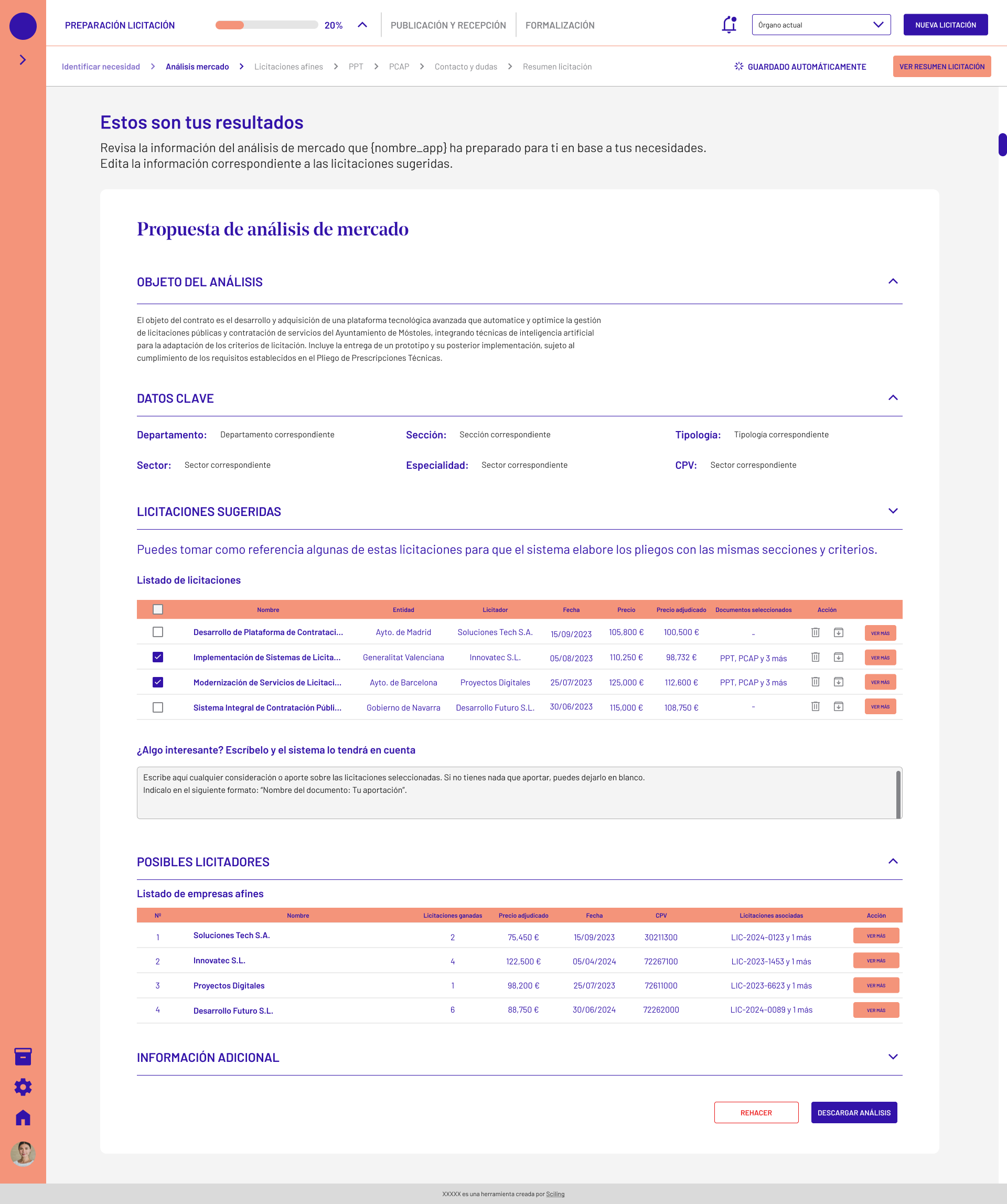
Product & UI decisions
Translating legal language into usable and interactive patterns
Translating a legal process into a usable tool was not just a matter of interface. It meant deciding how the product should function as a whole.
- Guided flow and document generationWe replaced the document management model with a sequential flow that reflects the actual legal process order. Users advance step by step without skipping phases, allowing them to go back to correct and guaranteeing regulatory rigor. In document generation, the system allows editing in external tools like Word and reintegrating the document as part of the work, facilitating editing and minimally changing their current workflow.
- Status-based navigation and legal languageNavigation was designed as a status-oriented system. At all times, the user can see where they are in the process, what they have completed and what remains pending. In a long, sequential process, this constant orientation is more useful than any traditional menu. Another key decision was not hiding legal language. Simplifying it would have reduced apparent complexity but also eliminated precision. Instead, technical terms were maintained, organized and presented so they could be used without friction.
- AI interaction designThe technical team handled the functional and technology side, so my work was designing the moment when the user encounters that technology: how results are presented, how actions are undone and how traceability of each automatic step is guaranteed to avoid the 'black box' feeling.
- Algorithmic transparencyWe turned the requirement of 'justifying awards before potential challenges' into a design and information hierarchy problem: highlighted numerical result, immediate textual justification and detailed breakdown on demand.
- Jotty DS adaptationThe existing visual and typographic library was adjusted, reformulating patterns with profiles of varying digital skill levels in mind. The goal was not visual innovation but reducing friction in complex interactions.
- Multi-role architectureThe system contemplates three access profiles (administrator, procurement officer and reviewer) with interfaces adapted to each. Defining that separation from the start was vital since in a legal environment it's essential to be clear about roles and their responsibilities to avoid failures.
AI in the product
Eliminating the black box to build user trust
The procurement document defined what artificial intelligence had to do and the technical team decided how to implement it. My responsibility was designing the experience layer that makes those results comprehensible, controllable and auditable by the municipal officers who receive them. AI was present at multiple points in the process, but the real challenge was not technical — it was experiential: how to present automatically generated results in a way that built trust rather than uncertainty. The design premise is to make the system propose, but never decide for the user. This translates into a consistent sequence throughout the product, where each result can be reviewed, modified and explicitly validated before being finalized.
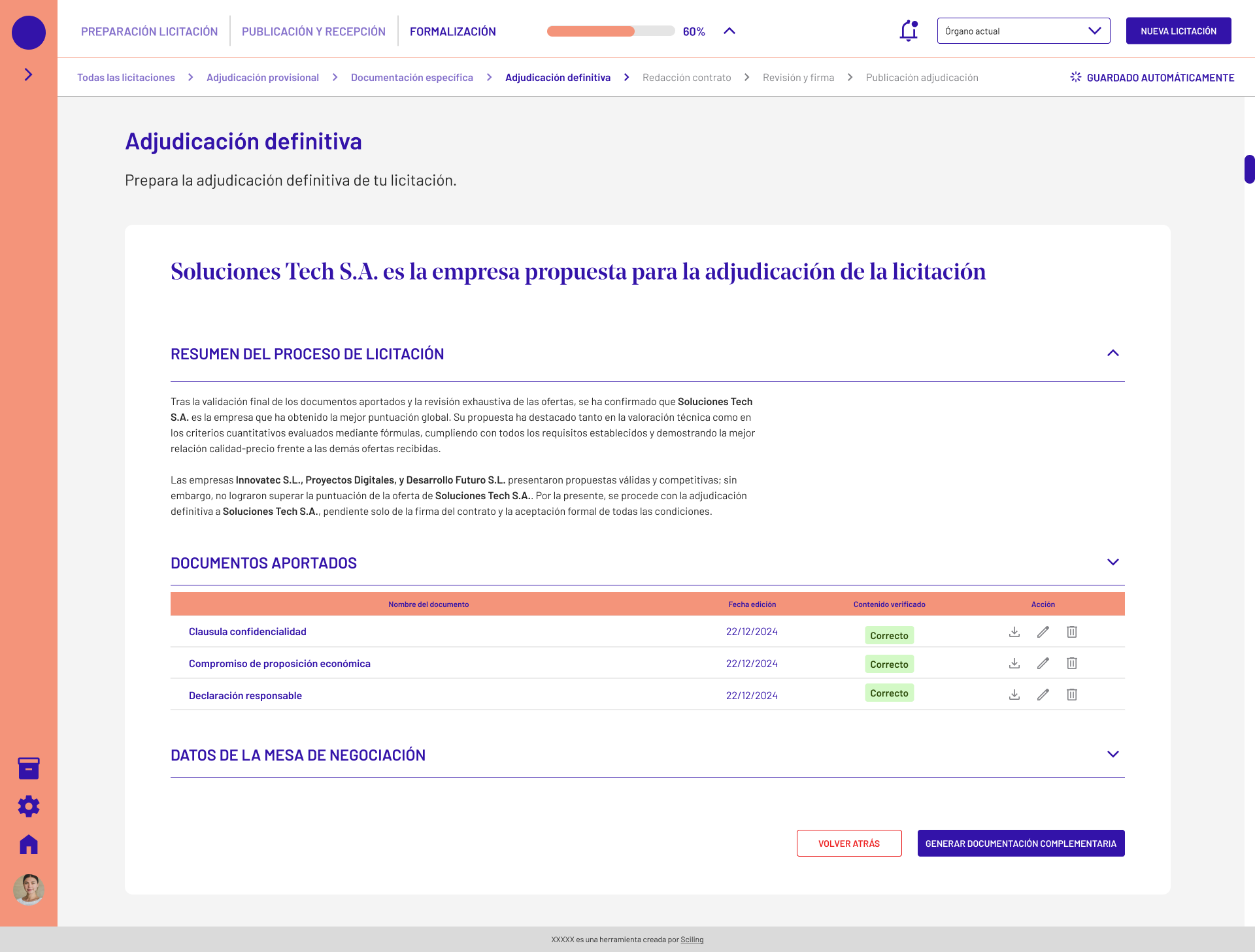
The system shows who wins, why, and the details of the selection process — traceable and auditable.
Control
The "Redo" button is always visible on all generated results, and fields lock only when the user has completed the entire cycle. The system never considers something closed that the user has not explicitly closed.
Input
At least four points in the flow feature the same field: "Anything you want to highlight? Write it and the system will take it into account." Deciding to include it, and framing it this way, was a decision about who controls the context that the AI receives.
Transparency
The technical evaluation result includes an adequacy percentage, textual justification and a per-company breakdown on demand. Showing the reasoning, not just the verdict, addresses a legal requirement solved as an information hierarchy problem.
Results
From technical prescription to 'ready-to-build' in just four weeks
In one month I designed the experience and interface of a complete product in an unknown domain, covering the procurement process end-to-end and connecting more than twenty screens in a coherent flow.
The prototype had the potential to demonstrate that it was possible to automate critical parts of a legally-binding process while keeping the user informed, in control and able to reverse each automatic step.
1 month
To design an end-to-end product in an unknown domain
3 phases
Of the procurement process covered with more than 20 screens
1 DS
Adapted, not built from scratch, freeing time for critical flows
Complete flow of creating a tender through the platform.
Aprendizajes
What I learned
Designing in an unknown domain, under time pressure and with strict legal frameworks left learnings that cannot be gained in other types of projects.
01
Understanding context and technology is an indispensable part of design
I had to understand public procurement in parallel with interface decisions. I reaffirmed that it's key to quickly identify what you need to understand to avoid making costly mistakes, and what you can learn along the way.
02
AI must be explained when errors have real consequences
In a context like this, it's more important than ever for users to know what is happening. We designed not just the experience but also the trust, treating with special care that the AI is visible, explained and easily revisable.
03
Sometimes the existing system is the best decision
Building the design system from scratch would have been the most visible and the least intelligent decision. Reusing Jotty's with adaptations let me concentrate the month where it mattered. Knowing when not to build something new is betting on judgment.
Let's talk
Do you have a project?
I'm open to product design projects, branding and collaborations that make human sense. Tell me what you're thinking.